
I get some version of the same question almost weekly, usually from someone who just picked up a jar of “kefir grains” online without realizing there were two entirely different things they could have ordered. It’s an easy mix-up. Both are called “kefir grains,” both look vaguely like small, rubbery cauliflower florets, and both promise the same general thing: a tangy, probiotic-rich fermented drink. But feed the wrong grains the wrong liquid, and nothing happens, or worse, your grains slowly die trying.
I’ve kept both cultures going in my kitchen for years now, side by side, for genuinely different reasons. Here’s the full comparison, grounded in the actual microbiology behind each one, not just the surface-level differences most guides stop at.
What Are Milk Kefir Grains?
Milk kefir grains are a symbiotic culture of bacteria and yeast, held together in a protein-and-polysaccharide matrix, that ferment dairy milk into kefir. They’re off-white, gelatinous, and genuinely do resemble small cauliflower florets, ranging from the size of a grain of rice up to a small walnut once mature.
Research using targeted qPCR analysis on multiple milk kefir samples found that Lactobacillus kefiranofaciens and Lactobacillus kefiri were present across every sample tested, though the surrounding cast of supporting bacteria and yeast species varied significantly from batch to batch, with individual kefirs typically hosting only two to three of the possible yeast species detected across the study (source: PMC). This variability is part of why homemade milk kefir from different sources can taste noticeably different, even though they’re all technically “kefir.”
What Are Water Kefir Grains?
Water kefir grains are a different symbiotic culture entirely, adapted to ferment sugar water rather than milk. They’re smaller, more translucent, and often described as crystal-like rather than cloudy, since they lack the dairy protein structure found in milk kefir grains.
Genomic research characterizing water kefir fermentation has identified lactic acid bacteria from the Lactobacillus, Leuconostoc, and Lactococcus genera, along with acetic acid bacteria like Acetobacter and Gluconobacter, and yeasts including Saccharomyces cerevisiae (source: PMC). A separate large-scale study analyzing 69 water kefir grain samples through shotgun metagenomics detected 96 distinct microbial species overall, with 18 potentially novel species never previously documented, underscoring just how variable and understudied this culture still is compared to its milk-based counterpart (source: PMC).
Side-by-Side Comparison
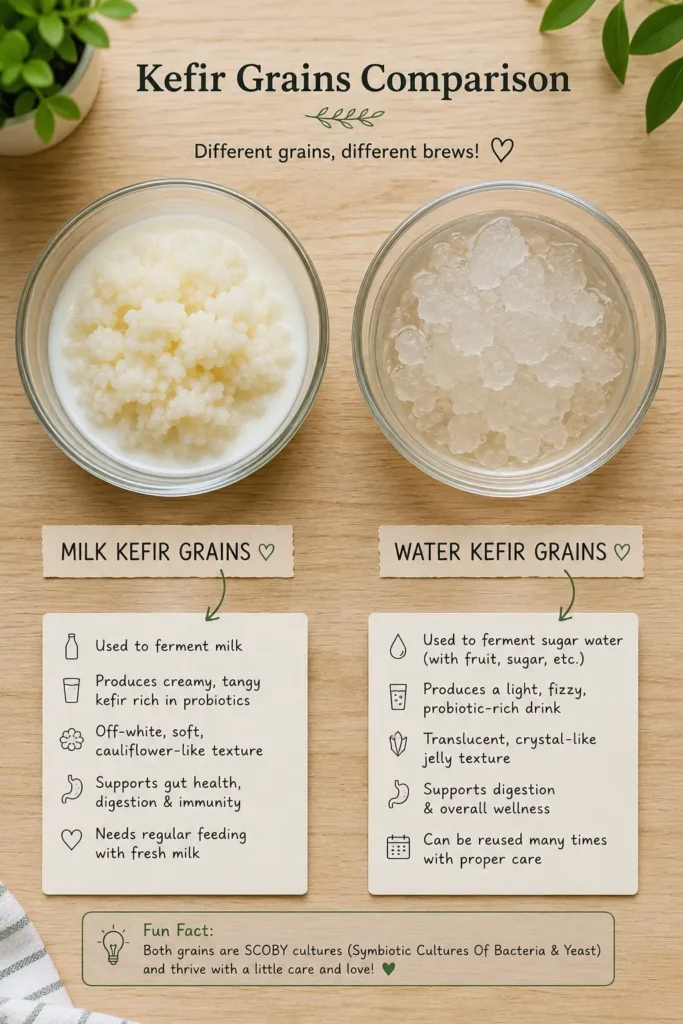
| Milk Kefir Grains | Water Kefir Grains | |
|---|---|---|
| Appearance | Off-white, cloudy, cauliflower-like | Translucent, crystal-like, smaller |
| Feeds on | Lactose (milk sugar) | Sucrose (cane sugar, coconut sugar) |
| Liquid medium | Dairy milk (cow, goat, sheep) | Sugar water, coconut water, or juice |
| Dominant genus | Lactobacillus kefiranofaciens, Lb. kefiri | Lactobacillus, Leuconostoc, Lactococcus, Acetobacter |
| Texture of finished drink | Thick, creamy, yogurt-adjacent | Thin, light, similar to sparkling lemonade |
| Flavor | Tangy, sour, rich | Mildly sweet, tangy, effervescent |
| Dairy-free? | No | Yes |
| Best for | Smoothies, baking, a yogurt substitute | A soda alternative, dairy-free diets |
Why You Can’t Swap One for the Other
This is the single most common mistake I see, and it’s an easy one to make when both cultures share the word “grains.” Milk kefir grains are adapted specifically to metabolize lactose, the sugar naturally found in dairy milk. Water kefir grains are adapted to metabolize sucrose and similar plant-based sugars instead. Put water kefir grains in milk, or milk kefir grains in sugar water, and the culture won’t have access to the sugar type it needs to thrive. At best, fermentation will be weak and inconsistent; at worst, the grains will slowly starve and die.
Which One Should You Start With?
- Start with milk kefir grains if: you drink dairy regularly, you want to bake or cook with kefir (our entire Kefir Sourdough collection runs on this), or you want the thicker, richer texture closer to drinkable yogurt.
- Start with water kefir grains if: you’re dairy-free or lactose intolerant, you want a lighter, soda-like beverage, or you’re mainly interested in flavoring your ferment with fruit and herbs.
- Consider both if: you want the full range of uses. Many experienced home fermenters, myself included, keep both going simultaneously for different purposes.
Care Differences Worth Knowing
Both cultures need regular feeding to stay healthy, but their storage tolerance differs slightly. One large-scale genomic study found that drying water kefir grains for storage significantly reduced their microbial diversity and negatively affected how well they grew back once rehydrated, a more pronounced effect than what’s typically reported for milk kefir grains stored using standard refrigeration methods (source: PMC). In practice, this means water kefir grains generally do better with consistent room-temperature feeding rather than long dehydrated storage, while milk kefir grains tolerate a slower-paced refrigerated rest more comfortably. For the full setup and troubleshooting process for milk kefir grains specifically, see our guide on What Are Kefir Grains?, which also covers how to store them long-term.
The Bridge Most Guides Miss: Using Kefir Beyond Drinking
Nearly every comparison guide stops at “which one should you drink,” but kefir’s usefulness doesn’t end there. Milk kefir in particular works as a genuine baking ingredient, not just a beverage. The same tang and moisture that make it distinct as a drink also make it a strong substitute for buttermilk or yogurt in bread dough. If you’ve gotten your milk kefir grains established and want a next step beyond drinking it plain, this is where a lot of people (myself included) end up spending most of their kefir. Our full Kefir Sourdough recipe collection walks through exactly how that works, starting with a kefir-based sourdough starter.
Explore More on Kefir Guide
- New to kefir grains entirely? Start with What Are Kefir Grains?
- Curious about the dairy-free version specifically? Read Water Kefir: What It Is and How to Make It at Home
- Want the full basics on kefir itself? See What Is Kefir?
- Ready to bake with your milk kefir grains? Browse our Kefir Sourdough recipes
Frequently Asked Questions
Can I convert milk kefir grains into water kefir grains, or vice versa?
No. These are genuinely distinct microbial cultures adapted over generations to their specific liquid medium. Attempting to convert one into the other doesn’t work; you would need to acquire the correct grain type separately.
Which type has more probiotic diversity?
Both host a wide, variable range of bacteria and yeast species, and research suggests water kefir specifically may host a broader-than-previously-known diversity, with recent metagenomic work identifying dozens of species and several entirely novel ones (source: PMC). Rather than one culture being definitively “more diverse,” the two host different, non-overlapping microbial communities suited to their environments.
Can I use plant-based milk with milk kefir grains?
Not reliably long-term. Milk kefir grains need the lactose found in dairy milk to stay healthy; plant-based milks lack this sugar, and grains fermented exclusively in plant milk will typically weaken over time. Some people occasionally ferment a batch in plant milk for immediate consumption, but return the grains to dairy milk afterward to keep them healthy.
Is one type easier for beginners?
Many people find water kefir slightly more forgiving to start with, since it ferments a bit faster and is more visually obvious when it’s ready (increased fizz, less sweetness). That said, both are genuinely beginner-friendly once you understand the basic feeding cycle.
Do both types need the same fermentation time?
Roughly, yes. Both typically take 24 to 48 hours at room temperature, though exact timing depends on your kitchen’s temperature and how active your specific grains are.

Hi, I’m Natalia Smith, a kefir enthusiast and content writer dedicated to making fermented dairy approachable and enjoyable. My journey with kefir began in my own kitchen, experimenting with recipes and sharing the health benefits I discovered. Through hands-on experience and continuous learning, I aim to provide clear, trustworthy information that helps others embrace the goodness of kefir in their daily lives.